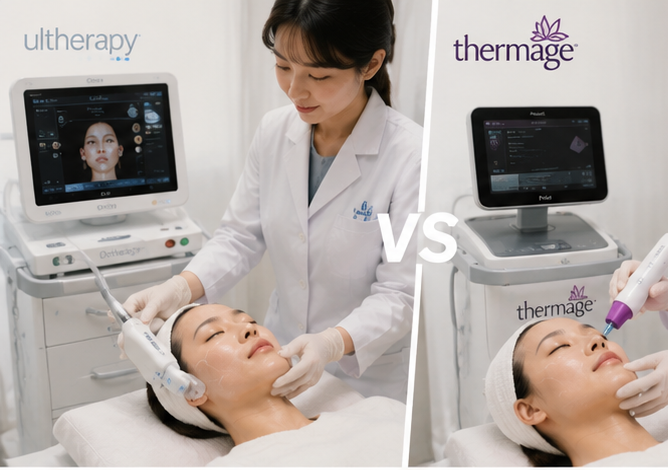
Non-surgical skin tightening has become one of the most sought-after treatments among international patients visiting Korea. Two devices dominate this space globally — Ultherapy and Thermage FLX — and Korean dermatologists are among the most experienced practitioners of both in the world. Understanding the difference between them is the first step toward choosing the right treatment for your skin.
How Each Technology Works
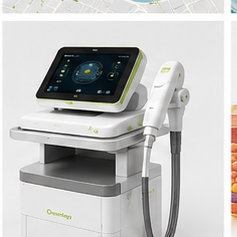
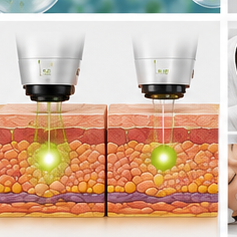
Ultherapy uses micro-focused ultrasound energy to stimulate collagen production deep within the skin, targeting the SMAS layer — the same foundational layer that surgeons address during facelifts. It is the only non-invasive treatment cleared by the FDA to lift skin on the neck, chin, and brow. Results develop gradually over 2–3 months as new collagen forms, with full effects visible at around six months.
Thermage FLX uses radiofrequency energy to heat the deeper layers of skin, stimulating collagen remodeling and producing a tightening and smoothing effect across the face and body. The latest generation covers more surface area in less time and includes a comfort-enhancing vibration mechanism. Results can last 1–2 years and are particularly effective for overall skin texture improvement.
The choice between Ultherapy and Thermage comes down to your primary concern. Ultherapy excels when the main issue is sagging or drooping — particularly around the jawline, neck, and brow. Thermage is the stronger choice when the concern is overall skin texture, fine lines, and a general tightening and smoothing effect across a larger surface area.
Many Korean dermatologists recommend combining both treatments for patients who want comprehensive anti-aging results — Ultherapy for structural lifting and Thermage for surface quality improvement. This combination approach is particularly popular among international patients who travel to Korea specifically to maximize results in a single visit.
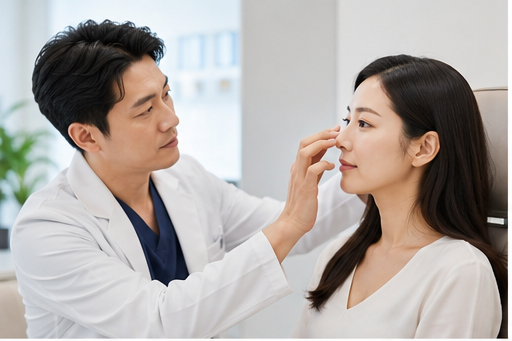
💡 Good to know: Korean dermatologists often customize the number of treatment lines and energy settings based on your specific skin laxity and anatomy — rather than applying a standard protocol to every patient. This individualized approach is one of the key reasons outcomes at Korean clinics tend to be superior.
What to Expect During and After Treatment
Both treatments are performed in a single session with no incisions and no general anesthesia. Ultherapy involves a series of focused ultrasound pulses that some patients find mildly uncomfortable — Korean clinics often apply topical numbing cream beforehand. Thermage FLX incorporates a vibration mechanism that significantly improves comfort compared to earlier generations. Expect mild redness and swelling for 24–48 hours after either procedure, after which you can return to normal activities immediately.